Mathis Bourgnon won the Mini Transat 2025. The hard part was sailing back
Mathis Bourgnon won the prototype class of the Mini Transat 2025, then set off nine days later on the same 6.50 metre boat to cross the North Atlantic alone, in winter. Speaking to Windward Türkiye, he talked about a campaign that lost its insurance for seven months, a start line where nobody saw him as the favourite, and a storm he rode out without a mainsail.
 Written by Rana Akkurt
Listen to the episode
MATHIS BOURGNON IN BRIEF
Who. 29, French and Swiss. Started racing at 19. His father Yvan Bourgnon won the Mini Transat in 1995.
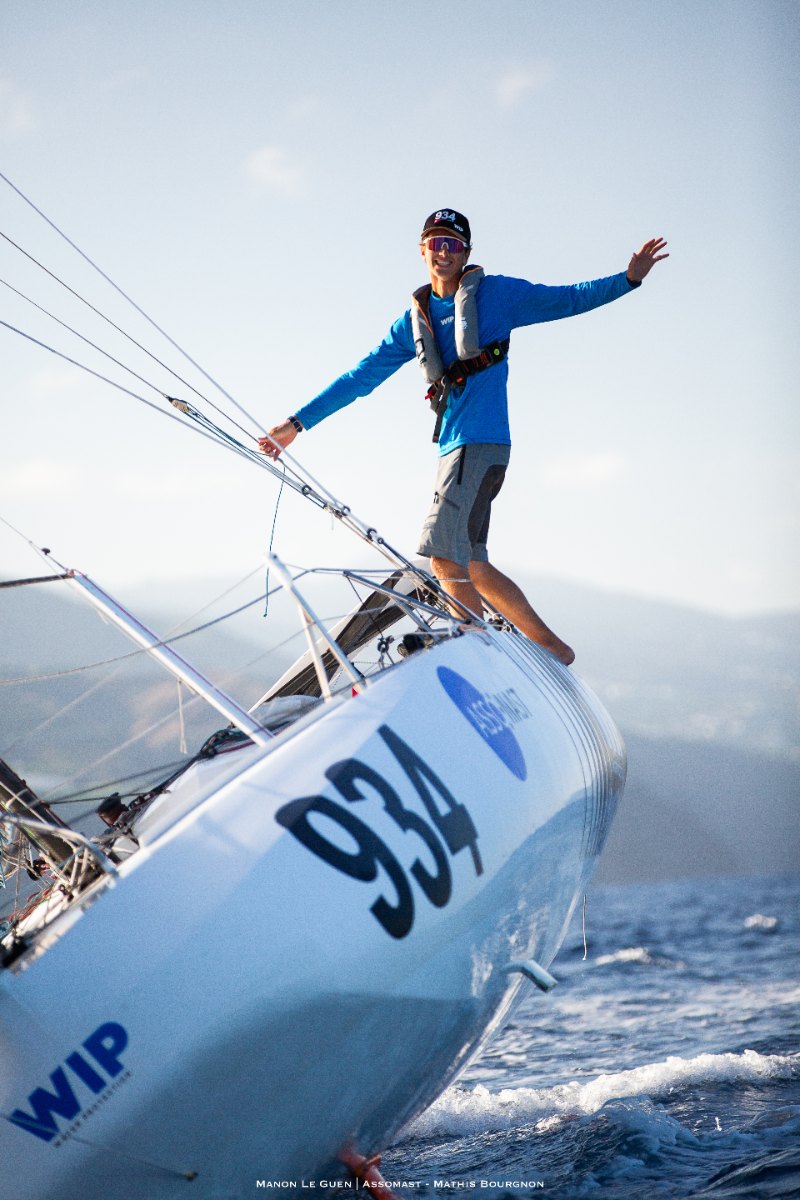
Boat. Mini 6.50 prototype number 934, LiliWIP, designed by Étienne Bertrand in 2017. The campaign is called Défi Assomast.
Race. Winner of the prototype class, Mini Transat 2025. Started from the Canary Islands on 25 October, finished in Guadeloupe on 8 November after 13 days and 18 hours, 18 miles ahead of the next boat.
Return. Left Guadeloupe alone on 17 November and sailed into Horta, in the Azores, on 9 December.
On the afternoon of 7 November 2025, with less than 200 miles to Guadeloupe, prototype number 934 was about 20 miles behind the race favourite Benoît Marie. Marie had won the race in 2013 and had just set a class record of 352 miles in 24 hours on this leg. Mathis Bourgnon closed the gap overnight at an average of 14 knots, got past him in the final gybes off Petite Terre and crossed the line at Saint-François on the morning of 8 November with an 18 mile lead. The 2,600 mile leg from Santa Cruz de La Palma had taken 13 days and 18 hours. His first words on the pontoon were “I’m still shaking”.
His father Yvan Bourgnon had won the same race thirty years earlier to the day, in 1995. Before the start, Mathis had told his family and his mental coach that he felt invincible, but winning was not what he meant. “I can be last, I can break my mast, I can finish tenth or fifth. I would feel okay with all of it. Because I will give everything, and nothing can really make me sad at the end.” He left the dock with nothing to lose, because a year earlier he had already lost almost everything.
The winning boat spent seven months ashore
The Mini Transat is a solo ocean race from France to the Caribbean on 6.50 metre boats. No internet on board, no weather routing from shore, forecasts come over the radio and every decision belongs to the sailor. The 2025 edition started from Les Sables d’Olonne on 21 September. After a storm stop the first leg was cancelled, and for the 89 boats that left the Canary Islands on 25 October the race came down to a single Atlantic crossing.
Mathis compares Mini sailors to the start-ups of offshore racing. Everybody has a limited budget and most people make the same mistake. “They buy a new mainsail before buying a new autopilot or batteries. Then you have no energy for the race. You go fast for two days and then you retire.” He credits his father for keeping him clear of that trap. The most valuable thing he took from Yvan Bourgnon, he says, was project management rather than sailing technique.
He announced the campaign in January 2023. The boat is an eight year old prototype drawn by Étienne Bertrand in 2017 for Offshore Team Germany, which as Lilienthal had finished second in the 2017 Mini Transat and third in 2019. No ballast, a canting keel, a structure built for foils. Mathis refitted it on a small budget and named it LiliWIP. The first season ended after two races. In May 2023 he hit a rock with the keel. The damage was partial but enough to let water in. After that the insurer declined to continue. A Mini without insurance cannot be launched, cannot train, cannot race. From October 2024 to May 2025 the boat sat ashore while Mathis spent seven months looking for a company willing to cover him.
The insurer that had dropped him changed its mind in May. By then the first races of the season had gone and the Mini Transat was four months away. Most French Mini sailors train in groups with coaches, at structures such as Lorient Grand Large or in La Trinité-sur-Mer. Mathis belonged to none of them. He used the remaining races as training and deliberately tried new things in each one, sometimes the wrong sail, sometimes an unusual manoeuvre. He broke almost everything on the boat except the hull and the mast. Ropes, the spinnaker pole, rudders. When something failed he went back to the old method, and when it worked he learned twice as fast as those who never tried. In July 2025 he finished second overall in the Transgascogne. He arrived at the start line as an outsider, but he had seen that in trade wind conditions he was one of the two or three fastest boats in the fleet, and his rivals had not.
Across the Atlantic with one spinnaker
Four hours into the cancelled first leg, Mathis’s brand new medium spinnaker tore. The sailmaker admitted a manufacturing fault. Class rules allow almost any part to be replaced during the race, but not sails. Mathis asked for an identical replacement and the class office refused. That left two options. Take a medium spinnaker and accept a 24 hour penalty, or leave with only the big spinnaker. He chose the second and sailed the 2,600 mile, mostly downwind leg with a single spinnaker. His rivals called it an example of sportsmanship.
He does not remember feeling stressed during the race. Even if something broke, he would not let his emotions drain his energy, because the real job was to save energy, stay awake and manage sleep. In the 50 days he spent at sea that year he never slept a full night, getting by on around 900 naps of 20 minutes. One night a whale struck the side of the boat with its tail, and he says he was truly frightened. On the second leg he covered 315 miles in 24 hours. The rest of the time, he says, he enjoyed the wind, the clouds and surfing a 6.50 down the waves.
The hard part was sailing back
Mini Transat winners usually ship their boats back to Europe by cargo. On 17 November, nine days after the finish, Mathis left Saint-François on the same boat. The decision had been made before the race. His goal was to become the first Mini sailor to sail back alone in winter straight after the Mini Transat. The trade winds blow from east to west, so the outbound crossing is hard but comparatively easy. Coming back means heading north against wind and current, through the winter lows of the North Atlantic. Colder, with longer nights. Mini sailors have done this route in spring and summer. Nobody had done it in winter, right after the race. As a delivery passage, weather routing from shore was allowed, and his father took that job.
In early December, approaching the Azores, the port rudder bearing failed completely and the mainsail tore. In the same days the Ocean Fifty, IMOCA and Class40 fleets returning from the Transat Café L’Or were ducking into Horta to wait out a Biscay storm. Mathis met the front, forecast at over 45 knots with 6 to 7 metre seas, without a mainsail and on one rudder, in 4 metre waves and close to 50 knots of wind. He described it afterwards. “Yesterday I was really scared, the waves were completely covering the boat. I told myself that if I capsized, I was ready to jump with my liferaft.” At dawn on 9 December he sailed into Horta, on the island of Faial. He had completed his second solo Atlantic crossing of the season, from Guadeloupe to the Azores, in winter. He says the return was far harder than the Mini Transat itself.
The film of the voyage, “Vive l’Atlantique”, was directed by Maxence Peyras and is currently being shown at sailing clubs. Mathis plans to release it on YouTube with English subtitles in mid November. He received the French Sailing Federation’s 2025 Champions Trophy in the offshore category and appeared on the covers of Seahorse and Skippers. In October 2026 he skippered a VOR 70 in the Rolex Middle Sea Race.
One week of sailing a year
Because of his surname, people assume he has been racing since birth. The truth is the opposite. Mathis is 29, with a French mother and a Swiss father. He grew up in Normandy, far from the sea. As a child, sailing was one week a year, on holiday with his father. Optimist, Laser, club racing, none of it. He went to Paris to study and entered his first race after the age of 18, a student event. Catamarans first, then offshore. His first race on a Mini 6.50 was in April 2023, as crew on Alexia Barrier’s boat.
Those weeks were no ordinary holidays. At fifteen or sixteen he and his father would take a beach catamaran offshore, sleeping on the trampoline for a week or two, in the cold, always at risk of capsizing. That is where his confidence comes from. He sums up the effect of the surname as “fifty percent positive, fifty percent negative”. The negative side was the assumptions of the media and the people around the race. The positive side was that, knowing how late he had started, he never felt any pressure.
The name on the boat belongs to a cousin
The campaign is called Défi Assomast. Assomast is a French association supporting people with mastocytosis, a rare disease caused by an excess of mast cells, part of the immune system, building up in the body. Mathis’s cousin Marie lives with it. He knew he could not help her directly. Putting the association’s name on the boat was the indirect help he could offer.
The association followed the race closely. People living with the disease came to the boat at the start, and a boy of about twelve gave Mathis a small compass. That compass was on board for both Atlantic crossings. Nobody was asked for donations, there was no time to build a campaign. People donated anyway.
Going where the fear is
Mathis does not like to say he has dreams. He prefers to say he has projects, and he thinks he is already living the dream. He chose the return voyage because it scared him. His philosophy is simple. If you go towards your fears you push yourself like never before, and that is where you learn the most. Now he is looking for what scares him next. He saw five metre waves on the way back, so perhaps seven metres. Perhaps going somewhere with whales, to leave that fear behind too.
Then there is the poster on his bedroom wall. The ORMA 60 trimarans of the 1990s and 2000s. Hugely powerful, easy to capsize, possibly the most extreme boats even today. His father and his uncle Laurent Bourgnon raced them. Sailing one of those trimarans one day is the only thing Mathis is willing to call a dream.
His advice to young sailors dreaming of solo racing may sound like a contradiction, but it comes from the same place. Don’t start solo. Start double-handed, with someone you trust or someone experienced. On a two or three day passage, watches are unavoidable, and while the other person sleeps, the boat, the navigation and the manoeuvres are yours. It is very close to solo sailing without the sleep management, and it is where you get your first taste. Then go out alone for one night, 24 hours, a weekend, and come back. Not everybody likes it. In solo sailing the good moments are very good and the bad moments are very bad. He had just come back from the Middle Sea Race with a crew of 20 and he loves that too. But solo sailing gives you something else. Bow, helm, pit, autopilot, you learn all of it on your own.
His message to sailors in Türkiye comes from the same place. “If you are afraid of something, go for it. If getting on a boat, entering a race or trying another role on board feels hard, it means you will learn a lot by doing it.”
This story is based on a conversation with Mathis Bourgnon recorded for the Windward Türkiye podcast.
Windward Türkiye, Mathis Bourgnon: “Don’t start solo”
Bateaux.com, Mathis Bourgnon remporte la Mini Transat 2025 après un final renversant
Bateaux.com, Mathis Bourgnon traversera l’Atlantique avec un seul spi
Yacht.de, Mathis Bourgnon was the unexpected winner of the Mini-Transat 2025
mathis-bourgnon.com, Défi ASSOMAST, Sain et sauf à Horta
Videos, interviews and live moments from the racecourse, on our Instagram.
@ruzgar.ustu
Follow on InstagramPodcast
Stories from sailing in Türkiye, told in English. Listen to Windward Türkiye on Spotify.
Listen on SpotifyRüzgar Üstü on Spotify
Keep reading
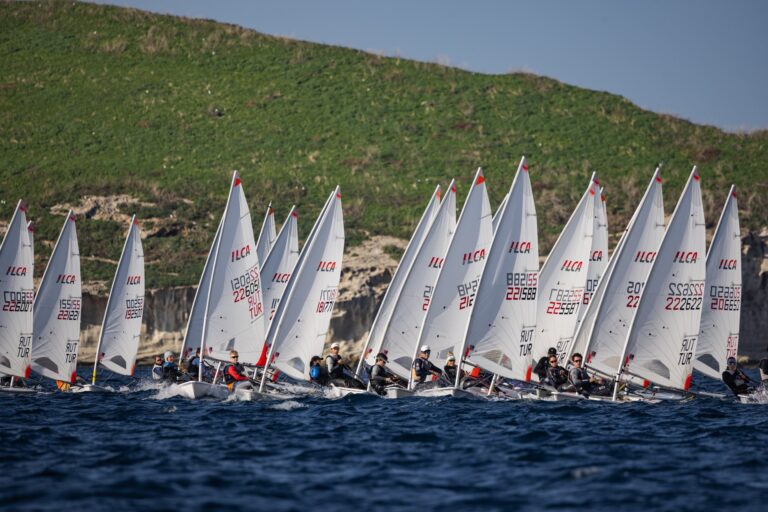
The second ILCA leg of the 2026-2027 TYF Sailing League concludes in Foça
Türkiye Yelken Federasyonu'nun MW Phokaia Beach Resort Kupası ILCA yarışları 18-22 Kasım 2026 tarihlerinde Foça'da yapıldı. 30 kulüpten 120 sporcu ILCA 4, ILCA 6 ve ILCA 7 sınıflarında yedişer yarış tamamladı.
Sailing’s first start at the European Games will come at Istanbul 2027, on Türkiye’s initiative
Sailing will feature at the European Games for the first time in Istanbul. Added to the programme on the initiative of the Turkish Sailing Federation, the sport will also offer quota places for the Los Angeles 2028 Olympic Games.
The first iQFoil leg of the 2026-2027 TYF Sailing League concluded in Foça
Milli takım seçme statüsündeki yarışlar 13-17 Kasım 2026 tarihlerinde Mark Warner Phokaia Beach Resort ev sahipliğinde yapıldı. 19 kulüpten 94 sporcu, U14'ten büyüklere kadar yedi filoda dört gün yarıştı.